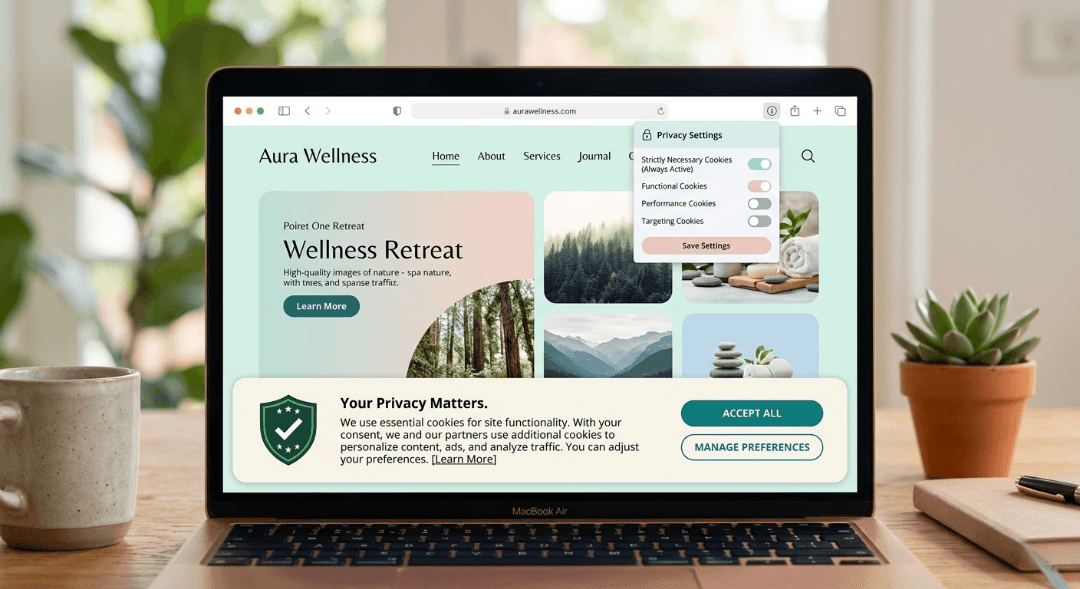

What Is a Privacy Policy and Why Every Website Legally Needs One in 2026
If you run a website, app, or digital product of any kind — you need a privacy policy.
This is not optional. It is a legal requirement under some of the world's most enforced data protection regulations, including GDPR, CCPA, PIPEDA, and LGPD.
Yet thousands of websites launch every day without one.
In 2026, regulators are more active than ever. Enforcement actions are rising. Fines are reaching record levels. And users are more privacy-conscious than at any point in history.
This guide explains exactly what a privacy policy is, what it must include, and how to create one that protects your business and your users.
What Is a Privacy Policy?
A privacy policy is a legal document that tells your users:
- What personal data you collect from them
- Why you collect it
- How you use it
- Who you share it with
- How long you keep it
- What their rights are
It is a public-facing document, usually accessible from your website footer, app settings, or account registration page.
Think of it as a transparency contract between you and your users — a commitment that you handle their data responsibly.
Why Is a Privacy Policy Legally Required?
Multiple global regulations make privacy policies mandatory. The key ones are:
GDPR (General Data Protection Regulation)
GDPR applies to any business processing data of EU residents — regardless of where the business is located. Under Article 13 and 14, you must inform users about your data processing activities in a clear, transparent way. A privacy policy is the primary mechanism for this.
CCPA / CPRA (California Consumer Privacy Act)
If you do business with California residents and meet certain thresholds, CCPA requires you to disclose what personal information you collect, sell, or share — and to provide users with opt-out rights.
PIPEDA (Canada)
Canada's federal privacy law requires businesses to be transparent about their data practices and to make their privacy policies publicly accessible.
LGPD (Brazil)
Brazil's Lei Geral de Proteção de Dados mirrors GDPR in many ways, including transparency obligations enforced through a published privacy policy.
Google and Apple App Store Requirements
If your app is listed on Google Play or the Apple App Store, both platforms require a publicly accessible privacy policy — regardless of what data your app collects.
Who Needs a Privacy Policy?
The short answer: almost everyone.
You need a privacy policy if your website or app:
- Has a contact form (collects name and email)
- Uses Google Analytics or any analytics tool (tracks IP addresses)
- Has a newsletter signup (collects email addresses)
- Uses cookies (including session cookies and third-party tracking)
- Has user accounts or login features
- Accepts payments (processes financial and personal data)
- Uses social login (Google, Facebook, Apple sign-in)
- Has a comments section
In practice, virtually every modern website qualifies. Even a simple blog with Google Analytics needs a privacy policy.
What Must a Privacy Policy Include?
The required contents vary slightly by jurisdiction, but a comprehensive privacy policy should always cover these core elements:
1. Identity and Contact Details
Who is collecting the data? Provide your company name, registered address, and a contact email — or the email of your Data Protection Officer (DPO) if you are required to appoint one.
2. What Data You Collect
List the categories of personal data you collect. This includes:
- Identification data (name, username)
- Contact data (email, phone number, address)
- Technical data (IP address, browser type, device ID)
- Usage data (pages visited, clicks, session duration)
- Financial data (payment card details, billing address)
- Communications (support tickets, chat logs)
3. Why You Collect It (Legal Basis Under GDPR)
Under GDPR, you must state your lawful basis for each type of processing. The main options are:
- Consent
- Contractual necessity
- Legal obligation
- Legitimate interests
4. How Long You Retain Data
State your data retention periods for each category of data, or the criteria used to determine retention periods.
5. Who You Share Data With
Disclose all third parties who receive user data. This includes:
- Analytics providers (Google Analytics, Mixpanel)
- Email platforms (Mailchimp, SendGrid)
- Payment processors (Stripe, PayPal)
- CRM tools (HubSpot, Salesforce)
- Advertising platforms (Google Ads, Facebook)
- Cloud hosting providers (AWS, Google Cloud)
6. International Data Transfers
If you transfer data outside the EU/EEA (e.g., to US-based tools), you must disclose this and explain the safeguards in place — such as Standard Contractual Clauses (SCCs).
7. User Rights
Under GDPR, users have eight rights. Under CCPA, they have several more. Your privacy policy must list all applicable rights and explain how users can exercise them:
- Right to access their data
- Right to rectification (correction)
- Right to erasure (the right to be forgotten)
- Right to data portability
- Right to object to processing
- Right to restrict processing
- Right to opt-out of sale of personal information (CCPA)
- Right not to be discriminated against for exercising rights (CCPA)
8. Cookie Usage
Briefly describe your use of cookies and tracking technologies, and link to your full cookie policy.
9. Children's Privacy
If your service is not directed at children under 13 (or under 16 in the EU), state this clearly. If it is, you have additional compliance obligations under COPPA and GDPR.
10. How to Contact You
Provide a clear mechanism for users to submit privacy requests, complaints, or questions.
11. Date of Last Update
Always include when your privacy policy was last updated. This is important for compliance documentation and user trust.
What Happens If You Don't Have a Privacy Policy?
The consequences of operating without a compliant privacy policy can be severe:
Regulatory Fines
GDPR fines can reach up to €20 million or 4% of global annual turnover — whichever is higher. CCPA violations can cost $7,500 per intentional violation. These are not hypothetical — enforcement actions are increasing every year.
Payment Processor Suspension
Stripe, PayPal, and other payment processors require a publicly visible privacy policy to maintain a merchant account. Missing one can result in account suspension and frozen funds.
App Store Removal
Both Google Play and the Apple App Store will remove apps that lack a privacy policy. This can immediately halt your user acquisition.
Loss of User Trust
In a 2025 survey, 87% of consumers said they would abandon a purchase if they could not find a clear privacy policy. Transparency drives conversion, not just compliance.
Failed Enterprise Sales
Enterprise procurement teams conduct security and privacy reviews. A missing or non-compliant privacy policy can kill a deal with a major customer.
Privacy Policy for Mobile Apps vs Websites
Mobile apps have additional requirements beyond standard websites:
- You must disclose permissions requested by the app (camera, location, contacts, microphone)
- You must explain push notification data practices
- Apple's App Privacy nutrition labels require granular disclosure of data categories
- Google's Data Safety section requires specific disclosure of data sharing and security practices
A website privacy policy is not automatically sufficient for a mobile app. Both need separate, platform-appropriate disclosures.
Privacy Policy for SaaS Platforms
SaaS companies face a dual compliance challenge:
- They are a data controller for their own users (employees, account admins)
- They are often a data processor for their customers' end users
This means SaaS companies need two distinct sets of privacy disclosures:
- A consumer-facing privacy policy for their website and platform users
- A Data Processing Agreement (DPA) for their business customers, describing how they handle customer data
The Problem With Free Templates
Many founders use free privacy policy generators or copy templates from other websites. This approach carries serious risks:
- Templates are not tailored to your specific data practices
- They are rarely updated when regulations change
- They often miss jurisdiction-specific requirements
- They may include inaccurate or misleading statements
- They will not hold up under regulatory scrutiny
Using a generic template may actually be worse than having no policy — because it creates a documented false statement about your data practices.
How to Write a Privacy Policy That Is Both Readable and Compliant
GDPR specifically requires that privacy notices be written in plain, clear language — not legal jargon. Here are best practices:
- Use short sentences and simple vocabulary
- Organize content with clear headings so users can navigate to relevant sections
- Use plain-language summaries before technical sections
- Avoid copying legal boilerplate that users won't understand
- Provide layered notices — a short summary version and a full detailed version
How Often Should You Update Your Privacy Policy?
Your privacy policy must stay accurate at all times. You should update it whenever:
- You start collecting new types of data
- You add new third-party tools that process user data
- You enter new markets with different regulatory requirements
- Relevant regulations are updated or new ones come into force
- Your business model changes significantly
At minimum, review your privacy policy annually and document each review in your compliance records.
How PolicyOwn Generates Compliant Privacy Policies
PolicyOwn was built to solve exactly this problem.
Instead of relying on static templates, PolicyOwn uses structured compliance logic to generate privacy policies that are:
- Tailored to your specific business type and data practices
- Jurisdiction-aware — covering GDPR, CCPA, LGPD, and more
- Written in plain English that users can understand
- Audit-ready and aligned with current regulatory standards
- Fully editable so you can customize for your needs
The process takes minutes, not weeks. And unlike a lawyer's draft, it can be updated instantly when your practices or regulations change.
Platforms like https://policyown.com/ generate privacy policies based on your actual data flows — not generic clauses that may or may not apply to your business.
Privacy Policy Checklist
Before publishing your privacy policy, verify it includes:
- Your company identity and contact details
- All categories of personal data collected
- The legal basis for each processing activity (GDPR)
- Data retention periods
- All third-party recipients of data
- International transfer disclosures and safeguards
- Full list of user rights and how to exercise them
- Cookie usage summary and link to cookie policy
- Children's privacy statement
- Complaint escalation mechanism (supervisory authority contact)
- Last updated date
Frequently Asked Questions
Is a privacy policy the same as a cookie policy?
No. A cookie policy specifically addresses cookies and tracking technologies. It can be a standalone document or a section within your privacy policy. Under GDPR, you generally need both — a comprehensive privacy policy and a specific cookie consent mechanism.
Can I use the same privacy policy for multiple websites?
Only if those websites collect the same types of data in the same ways. If they differ in their data practices, each site needs its own tailored policy.
Do I need a privacy policy if I don't collect personal data?
It is nearly impossible to run a modern website without collecting some form of personal data. Even passive analytics tools collect IP addresses, which is considered personal data under GDPR. So in practice, yes — you almost certainly need one.
What is the difference between a privacy policy and a data protection policy?
A privacy policy is external — it informs users about your data practices. A data protection policy is internal — it documents how your organization handles data protection obligations. Both are needed for full compliance.
Can I write my own privacy policy?
Yes, but it must be accurate, complete, and jurisdiction-compliant. Using an AI-powered compliance platform like PolicyOwn ensures that your policy is built on compliance logic rather than guesswork.
Final Thoughts
A privacy policy is not just a legal checkbox. It is a foundation of user trust and business credibility.
In 2026, the cost of non-compliance is too high to ignore. Fines are escalating. Enforcement is accelerating. Users are paying attention.
The good news is that creating a compliant, readable privacy policy has never been easier.
Start building your compliant privacy policy today at PolicyOwn — in minutes, not weeks.